Maxum Fitness X1 Functional Trainer Review
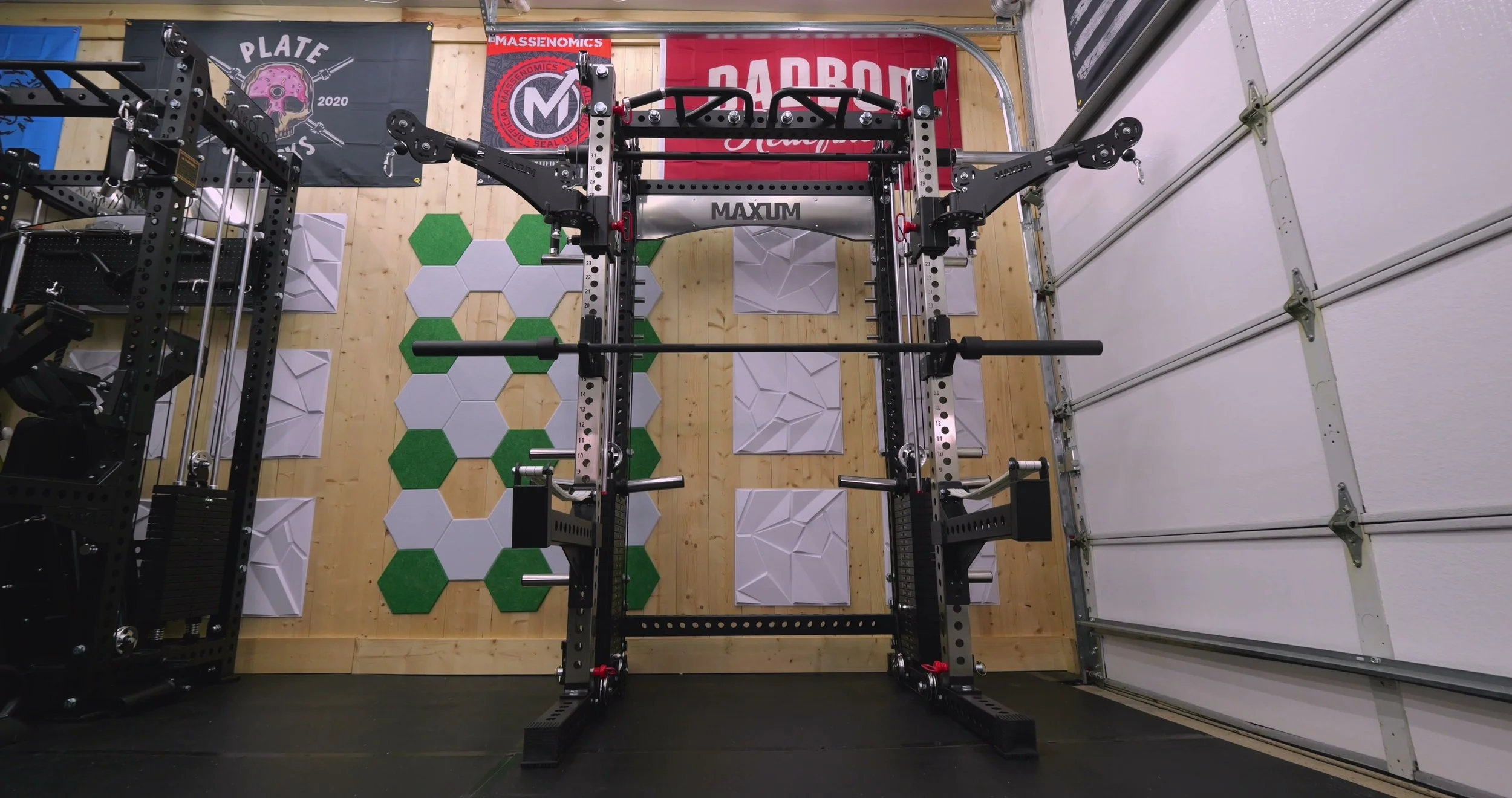
This product was in-house tested by Michael at The Jungle Gym Reviews.
The articulating arms are the reason to buy this—nine lateral angle positions and long reach give you a surprisingly wide functional trainer feel from a narrow rack. The biggest tradeoff is compatibility: the holes are true 1-inch with tight tolerance, and I ran into real fitment issues with certain “imperial” pins and attachments. If you want an all-in-one rack + functional trainer that’s flexible for real training variety and can scale heavier than most 2:1 stack systems, this is a strong option. If you’re buying specifically because you want to use a bunch of third-party Rogue Monster/imperial accessories without hassle, you need to go in with eyes open.
Quick Specs
Series: Maxum 3x3 series
Uprights: 3x3 (measured ~2.95” / ~75mm)
Steel: 11-gauge
Hole Size: 1-inch (true 1.00”)
Hole Spacing: Imperial spacing (as noted in use/testing)
Weight Stacks: Dual 220 lb stacks
Pulley Ratios: 2:1 (single-side use), 1:1 (combined)
Articulating Arm Positions: 9 lateral angle positions
Arm Length: ~22” from center of upright to end (as measured/compared)
Interior Width: 43”
Arms End-to-End Width (your fitment): ~96” (at 6’2” / ~74” wingspan)
Rack Height Options: 82” version (82.5” actual), 88” version (88.5” actual)
Front-to-Back Foot Depth: ~53” (back to front)
Crossmember Depth (between): 23”
Stack Plate Add-On Horns: Integrated horns on top of each stack for loading plates
Cable Feel (your rating): 8/10
Optional Smith Attachment: XSA Smith machine ($700–800, per your mention)
Where to Buy / Check Price
Check current price and availability on the official product page.
My Real-World Experience
The thing that jumps out immediately is that the articulating arms actually change how you use a home-gym rack. This isn’t just “dual pulleys on uprights.” The arms lock into nine different left-to-right angle positions, and because they’re mounted on roller trolleys, you can move them up and down easily on the front stainless steel uprights.
In practice, that means you can set one arm low for curls and the other high for pushdowns and actually get full range of motion on both—without fighting the cable angles. That’s the kind of real-world usability difference that makes you use the machine more often.
One detail I really like is the trolley design: there’s a pop pin on the side and four rollers at the corners, so the arms glide. I can move it one-handed in the demo, but day to day I still use two hands because the arms are long and awkward. Still, the “I’m actually willing to reposition this between movements” factor is high, and that matters on any functional trainer setup.
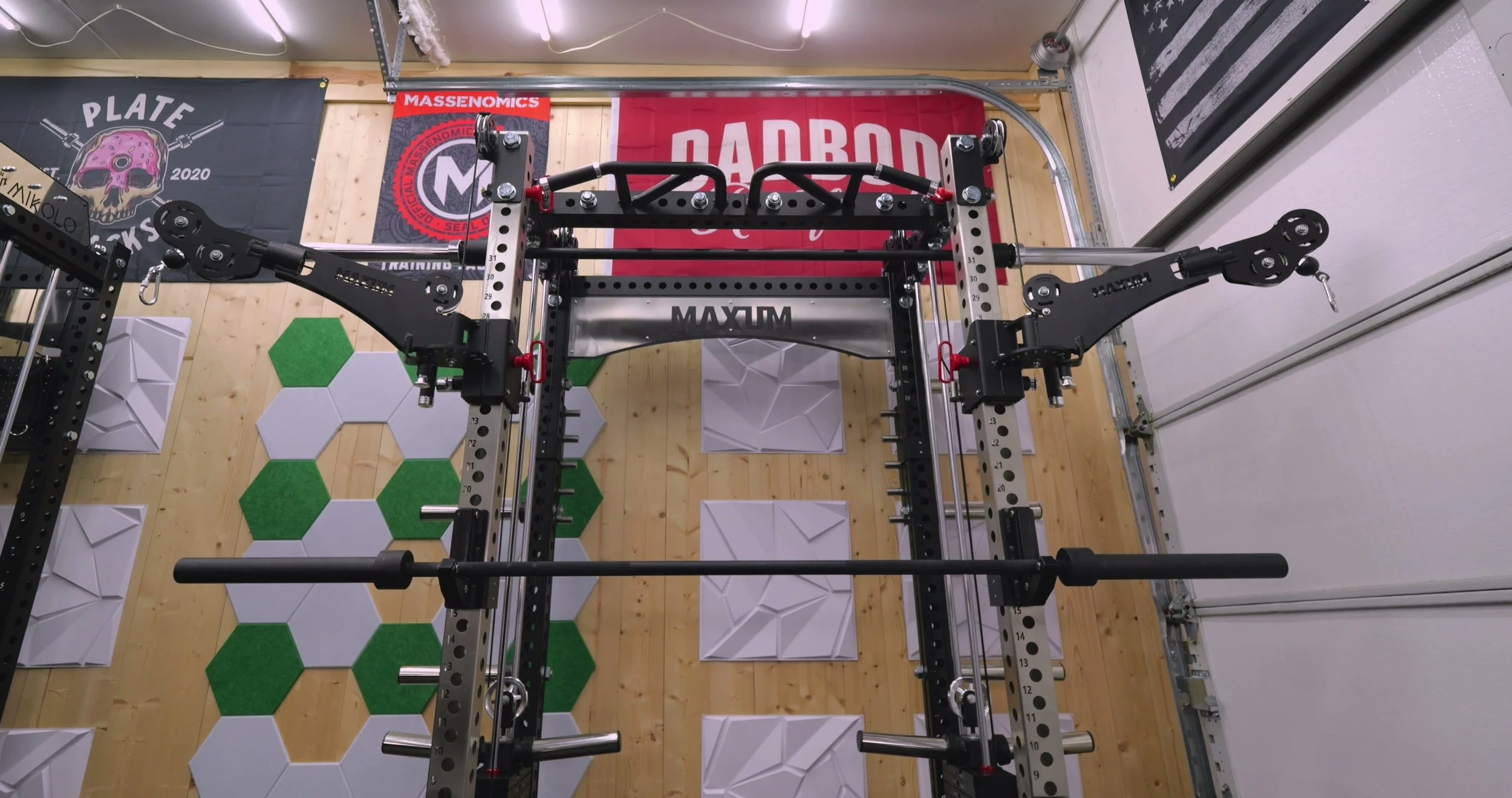
Compared to GetRX’d Tornado arms (which I’ve used and reviewed), Maxum’s version gives you smaller lateral increments (nine vs seven) and noticeably more reach—about 22 inches from the center of the uprights to the end versus the 16–17 inch ballpark on Tornado. That extra length is a big deal when you bring both arms toward the center for closer pulls, and it’s also a big deal when you swing them wide and want a true wide functional trainer feel.
For scale, I’m 6’2” with about a 74-inch wingspan. With the arms extended end-to-end, I measured about 96 inches wide. That’s basically the rack “doubling” its usable width when you want it to, while still living as a narrower-profile rack when you don’t.
Training Use Cases
Where this system shines is exactly what you’d expect from a rack + functional trainer hybrid, but with fewer compromises than usual.
For single-arm work, the arms being independent is huge. I can run curls low while keeping pushdowns set up higher. You’re not constantly re-rigging or moving one trolley up and down for every single movement.
For lat pulldowns, the included leg holder makes it workable in a home gym way: put a bench underneath, sit, pin your knees, and pull. At 6’2”, I’m close to maxing out the pulldown range, but I still get full range of motion and it feels great. If you’re around 6’5”, you’re going to be close to the top. Around 6’4”, you’re probably living with only a couple inches of clearance.
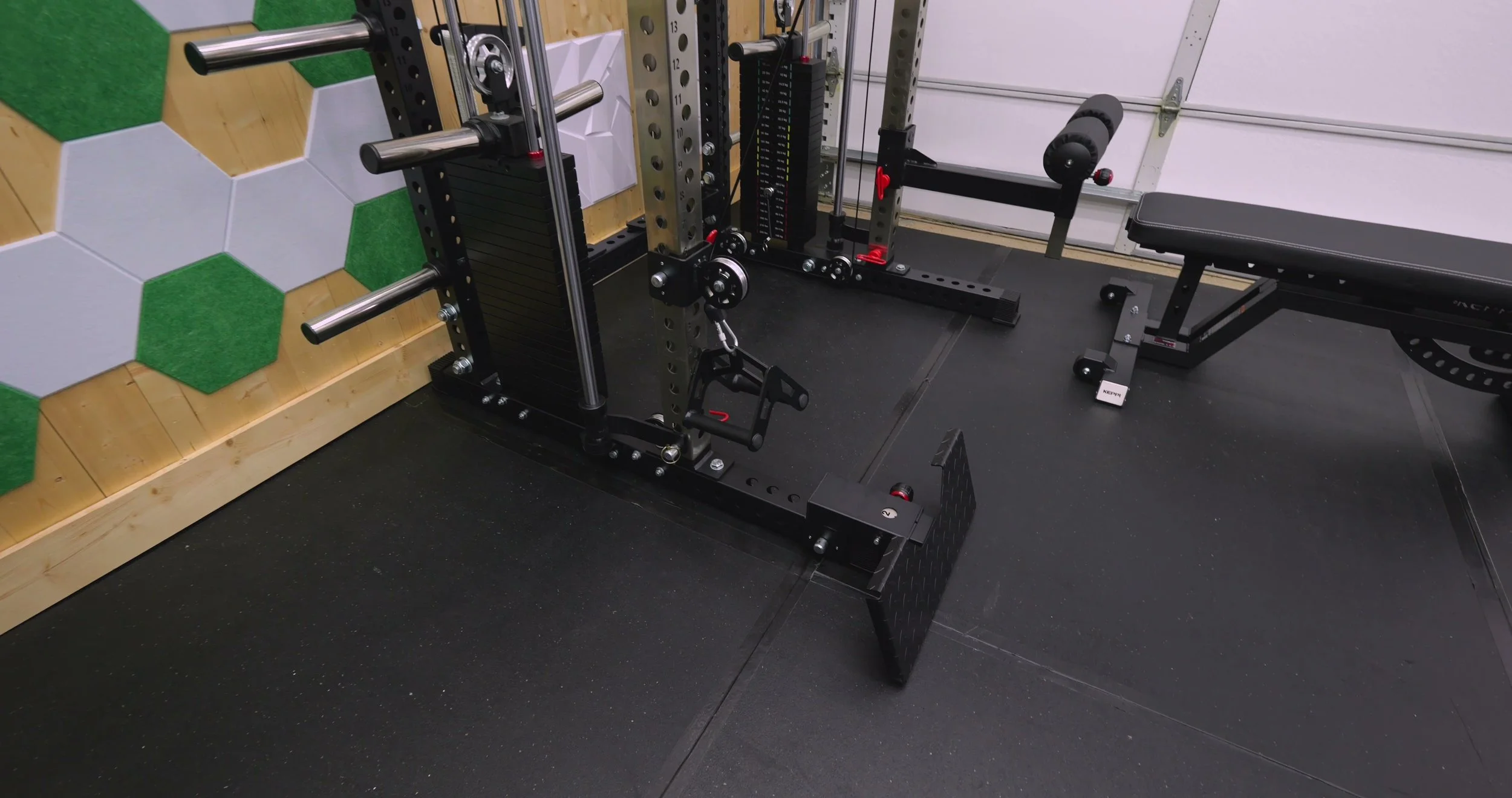
For low rows, this is where the workflow friction shows up for me. You can do it, and when you do it right it actually feels fantastic because the pulling point gives you a huge stretch and a good start height—but it takes extra setup. You need the additional cable/pulley and the low-row foot plate. Because the arms are long, you end up keeping the arm high so you don’t run out of travel, then building the low row setup from there. It’s not complicated, it’s just one more step, and that’s enough to make me do low rows less often than I should.
Tradeoffs and Limitations
The biggest real-world limitation is the one you can’t ignore if you care about attachments: the holes.
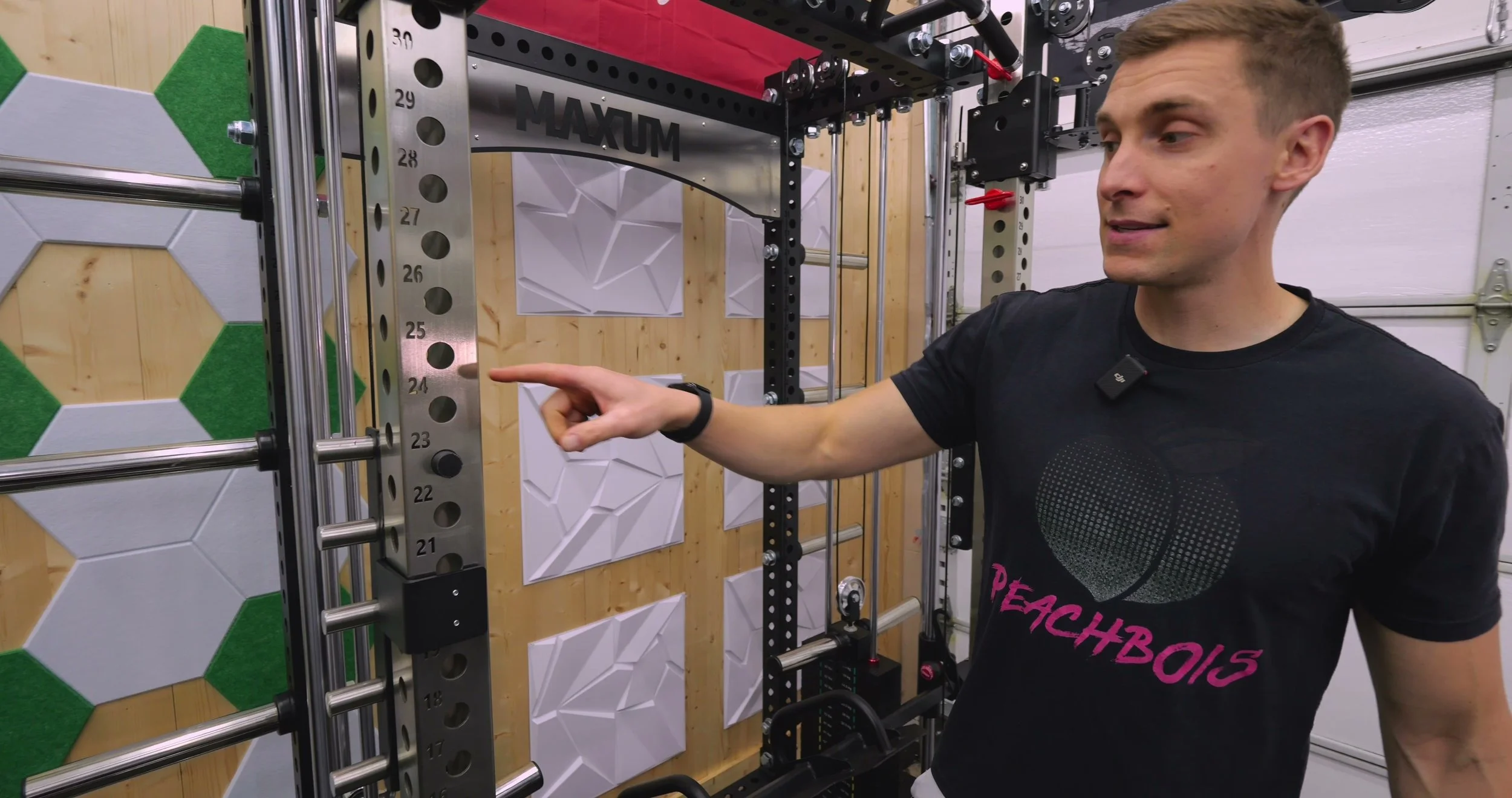
These are true 1-inch holes—exactly 1.00”. A lot of “1-inch” ecosystems from other companies run slightly oversized holes so pins and attachments slide in without drama. On this rack, I found certain imperial accessories simply don’t fit, and some are borderline. A Surplus Strength mag pin for imperial racks did not fit at all. A Rogue detent pin barely fit. I also found hole-to-hole variation—one hole might not accept something, the next one barely does, and another interior hole won’t. If you’re planning to mix in a bunch of third-party pins or specific mag-pin accessories, that’s the single biggest “buyer beware” point here.
There’s also a smaller, but real, compromise in adjustability compared to Tornado arms: Maxum’s arms move laterally, but they don’t have the same “quick up/down angle” adjustment that Tornado offers. Here, you unlock the trolley and move the whole arm up or down. It’s not a dealbreaker, but it is slightly less convenient when you’re changing angles mid-session.
One other note is that the arm isn’t perfectly centered within the rack. That’s part of how they avoid the arms colliding and how they enable the wide/narrow range. In use, it means single-sided movements can feel ever-so-slightly off-center. It’s not a “this is broken” issue—just something you notice if you’re picky.
Value and Alternatives
If you’re shopping this category, you’re basically trying to decide whether you want:
a rack-first system that happens to have cables, or
a functional-trainer-first system that happens to be a rack.
This leans toward functional-trainer-first because the articulating arms actually expand what you can do without constantly fighting cable angles.
The other value lever here is load scalability. The dual 220 lb stacks are already substantial for a home system, and the integrated horns on top of the stacks matter if you outgrow the stacks. In 2:1, you’re capped at a 110 lb feel per side from the stacks alone. When you combine the system for 1:1, you can hit 220 lb max when both stacks are maxed. And if you add plates to the horns, you can push it well beyond what most people expect from a stack-based home unit.
Where I think you need to be honest with yourself is attachment expectations. If you’re buying a system like this and you already own a pile of premium imperial accessories, the tight hole tolerance can turn into ongoing annoyance. If you’re fine living mostly in the Maxum ecosystem and only selectively adding third-party pieces that you’ve confirmed fit, the value proposition gets a lot stronger.
Who Should Buy This
Home gym owners who want a true rack + functional trainer centerpiece without a massive footprint.
People who will actually use articulating arms for real programming (not just as a novelty).
Lifters who want the option to scale beyond the stock stacks via integrated loading horns.
Anyone who cares about smooth, usable cable travel and will move trolleys frequently.
Who Should Skip It
Anyone buying specifically because they want effortless compatibility with a broad set of imperial/Monster-style mag pins and accessories.
People who want the fastest possible low-row workflow and hate multi-step setups.
Lifters who prioritize the “up/down angle adjustment” style of articulating arms over lateral-only positioning.
Final Verdict
The Maxum X1 is one of the most capable narrow-profile all-in-one racks I’ve used because the articulating arms actually deliver practical, repeatable training versatility. If you want a functional trainer that can “become wide” when you need it and still live like a compact rack the rest of the time, it checks a lot of boxes. Just don’t ignore the hole tolerance reality if third-party attachment compatibility is part of your buying plan.
Affiliate Disclosure
This article may contain affiliate links. If you buy through them, The Jungle Gym Reviews may earn a small commission at no extra cost to you.