STEPR+ Stair Climber Review
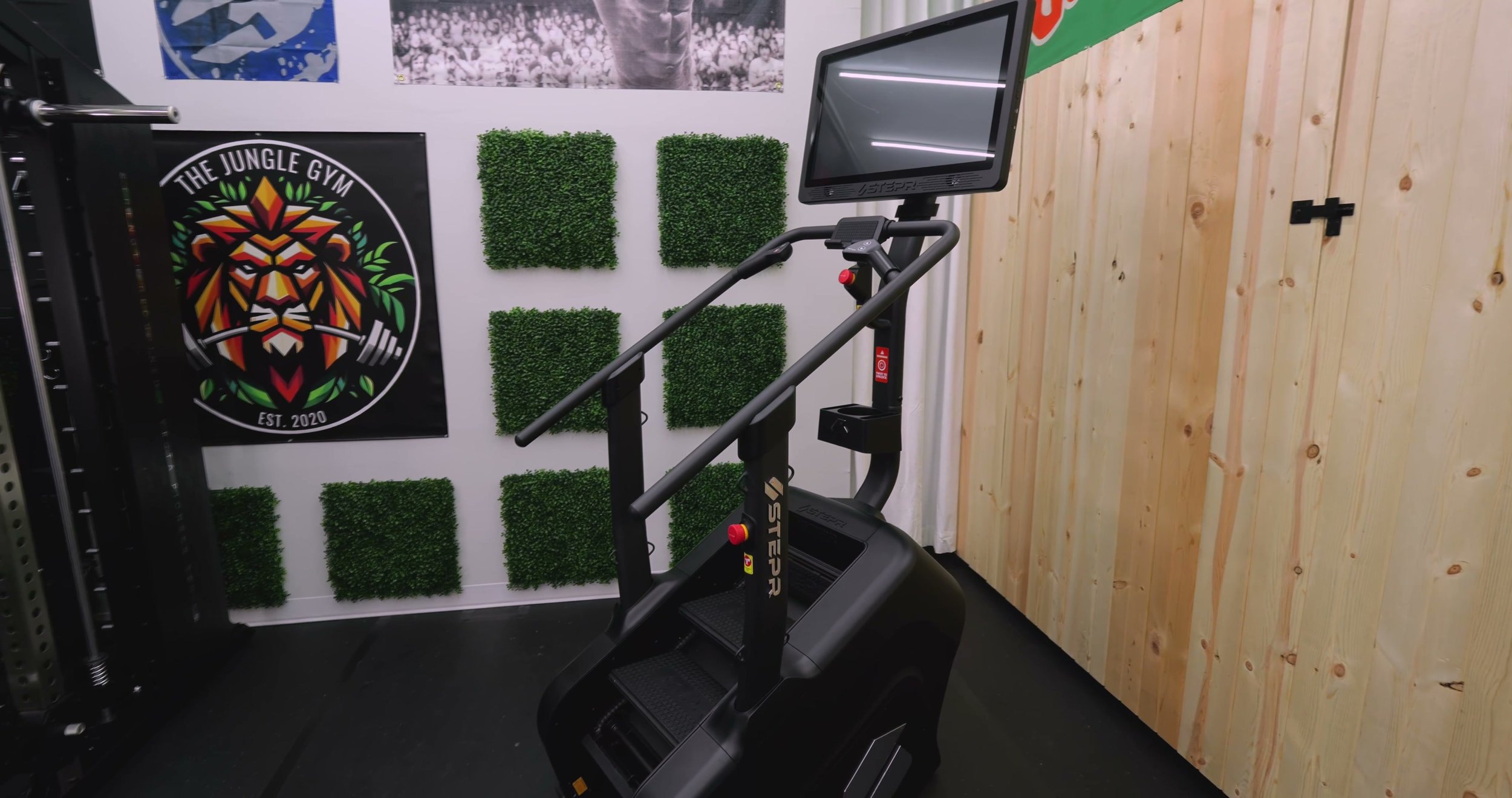
This product was in-house tested by Michael at The Jungle Gym Reviews.
The STEPR+ is a compact, connected stair climber built specifically for home gyms that can’t accommodate commercial machines. It nails the mechanical climbing experience in a footprint and height that actually work in residential spaces, but the smart touchscreen has a few real quirks that matter at this price. It’s best for people who want true stair climbing at home under 8-foot ceilings and are willing to accept some software friction. If you want a flawless connected experience or have very large feet, you should hesitate.
Quick Specs
Height: 82”
Footprint: ~50” long x 29” wide
Weight: 286 lb
Step Height: 5.2” (stadium steps)
Speed Levels: 20
Max Speed: 140 steps per minute
Display: 27” touchscreen (STEPR+)
Connectivity: Wi-Fi, Bluetooth
Warranty: 10-year frame, 2-year parts, 1-year labor
Price: ~$5,000 (STEPR+), ~$4,000–$4,200 (non-screen version)
Where to Buy the STEPR+
Check current pricing and availability on the official product page.
My Real-World Experience
A stair climber is one of those machines a lot of people miss when they leave a commercial gym, but the reality is that most stair climbers are enormous, heavy, and need more ceiling height than most homes can offer. That’s exactly the problem STEPR is trying to solve. This is a stair climber that fits through standard doorways, works under 8-foot ceilings, and still feels like a real gym machine when you’re actually using it.
I was part of the original pre-order for STEPR and put down a deposit early on. After several launch delays, I ended up canceling and going with a much cheaper Signature Fitness stair climber from Walmart, which I’ve reviewed separately. That machine is a solid value, but it doesn’t serve the same audience. I’m 6’2”, and until STEPR came along, there really wasn’t a compact stair climber designed for taller users in a normal home.
The STEPR+ stands 82 inches tall, which puts it safely under standard 8-foot ceilings. The footprint is compact for this category, and at 286 pounds it feels substantial without being unmanageable. From a pure space-planning standpoint, this is one of the only stair climbers that realistically works in basements, spare rooms, or garages without structural compromises.
Stadium Steps and How It Feels to Climb
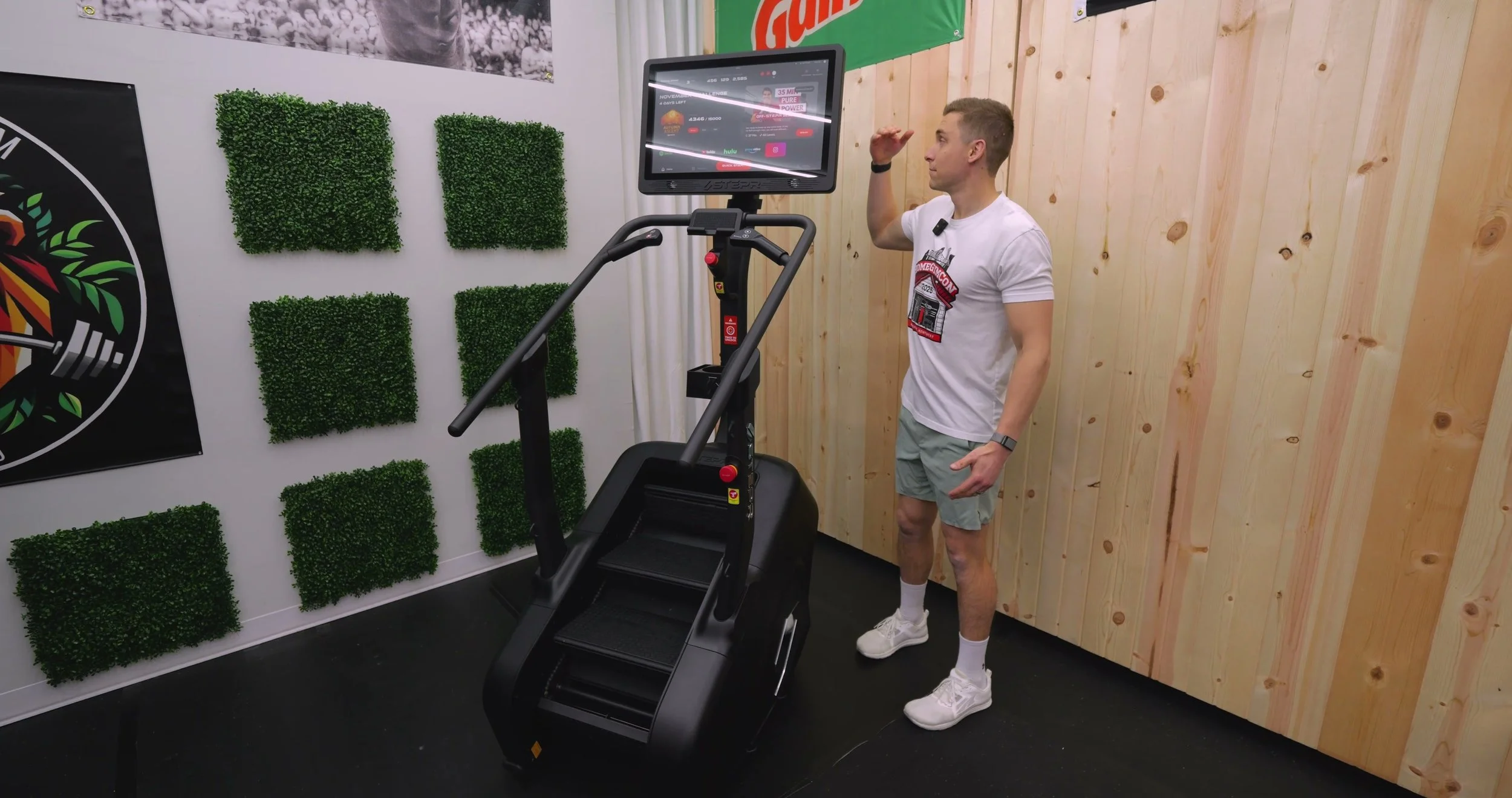
One of the defining features of the STEPR+ is the use of stadium steps. Each step is only 5.2 inches tall, which is much shorter than the 7-, 8-, or 9-inch steps you’ll find on most commercial stair climbers. At first, that sounds like a downgrade, but in practice I’ve come to really like it.
Because the steps are shallower, the movement feels more like hiking than climbing stairs. You’re not taking huge vertical steps every rep, which is easier on the joints. I’ve played soccer and have knee issues, and this is noticeably more comfortable for longer sessions. If you want more intensity, you can double-step or skip steps, but the baseline movement is gentler and more sustainable.
The tradeoff is depth. Because the unit is compact front-to-back, you don’t have a lot of room to move around on each step. Double-stepping is harder, and even single-stepping requires you to stay fairly centered. Once you move outside of roughly a two-foot usable zone, the stairs begin folding underneath again.
If you have large feet, this matters. I wear a size 12–12.5, and my foot hangs slightly off the front of each step. The steps are angled underneath so you can slide your foot in safely, but it takes some adjustment. If you’re size 13, 14, or larger, you’re likely going to feel cramped unless you move up to one of STEPR’s larger models, which also cost more.
Speed, Intensity, and Cardio Use
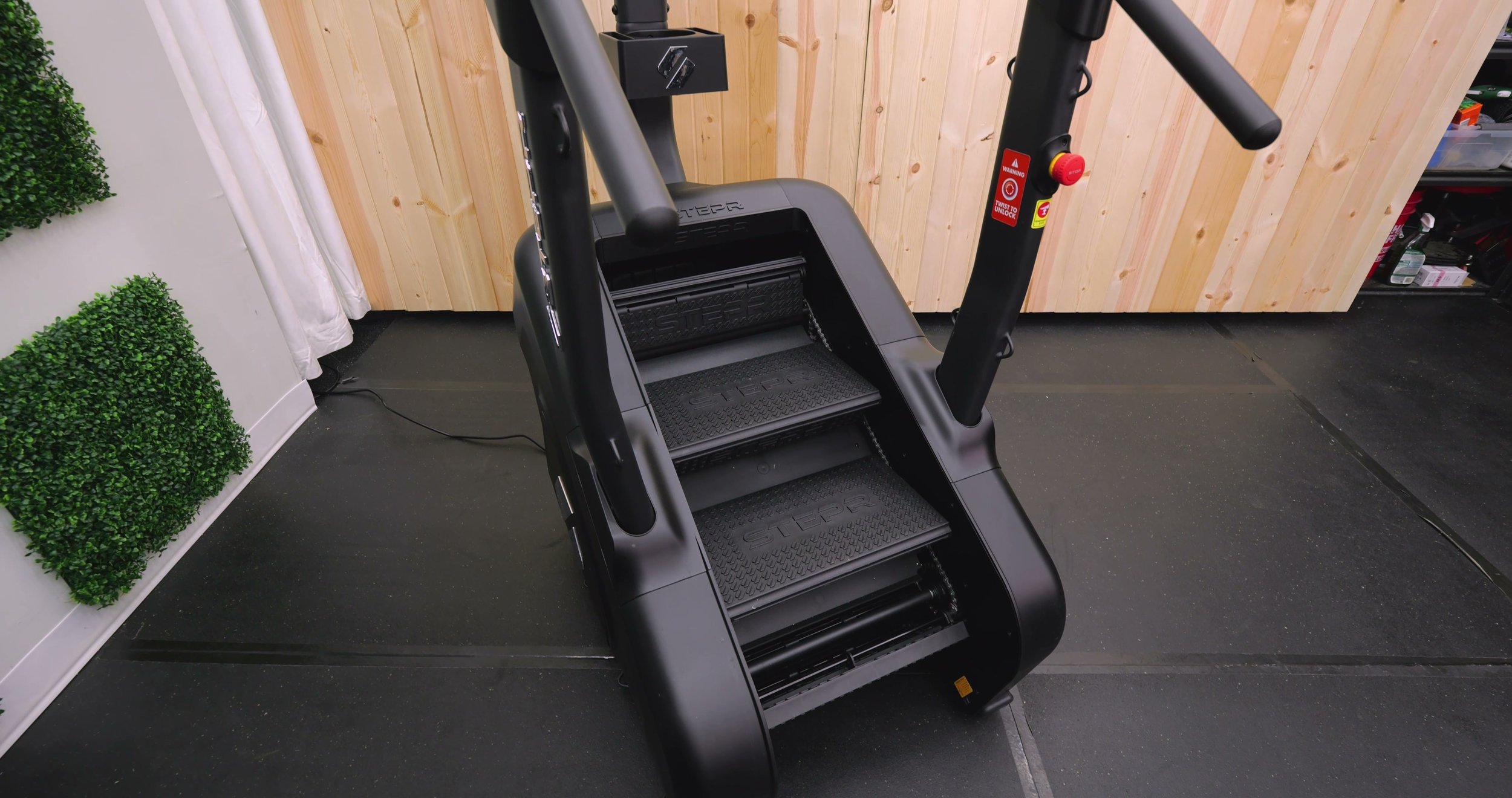
The STEPR+ has 20 speed levels, topping out at 140 steps per minute. At the low end, it’s extremely slow. At the high end, it’s brutally effective. On paper, the top speed is roughly equivalent to a 7 mph jog, but anyone who has used a stair climber knows that number doesn’t tell the full story. Within a minute, your heart rate is through the roof.
For my use, this has been excellent for Zone 2 cardio. I typically use it one to three times per week, with water, phone, and everything else right in reach. Mechanically, it behaves exactly how you want a stair climber to behave: start, stop, speed up, slow down, no surprises.
Safety, Portability, and Family-Friendly Features
One of my biggest concerns with stair climbers at home is safety, especially with kids around. STEPR handles this well. There’s an infrared safety sensor near the base that immediately stops the machine if something gets too close to the steps. There are also emergency stop buttons on both handles. Hit one and the machine locks completely until you reset it.
Moving the unit is easier than you’d expect. There are removable transport handles that thread into the lower frame and stick out about an inch. I’ve left mine installed permanently because they make it easy to tip the machine back and roll it like a wheelbarrow. Built-in front caster wheels help as well. Even without the handles, you can grab underneath, tip it back, and reposition it without too much effort.
Screen, Apps, and the Reality of a Connected System
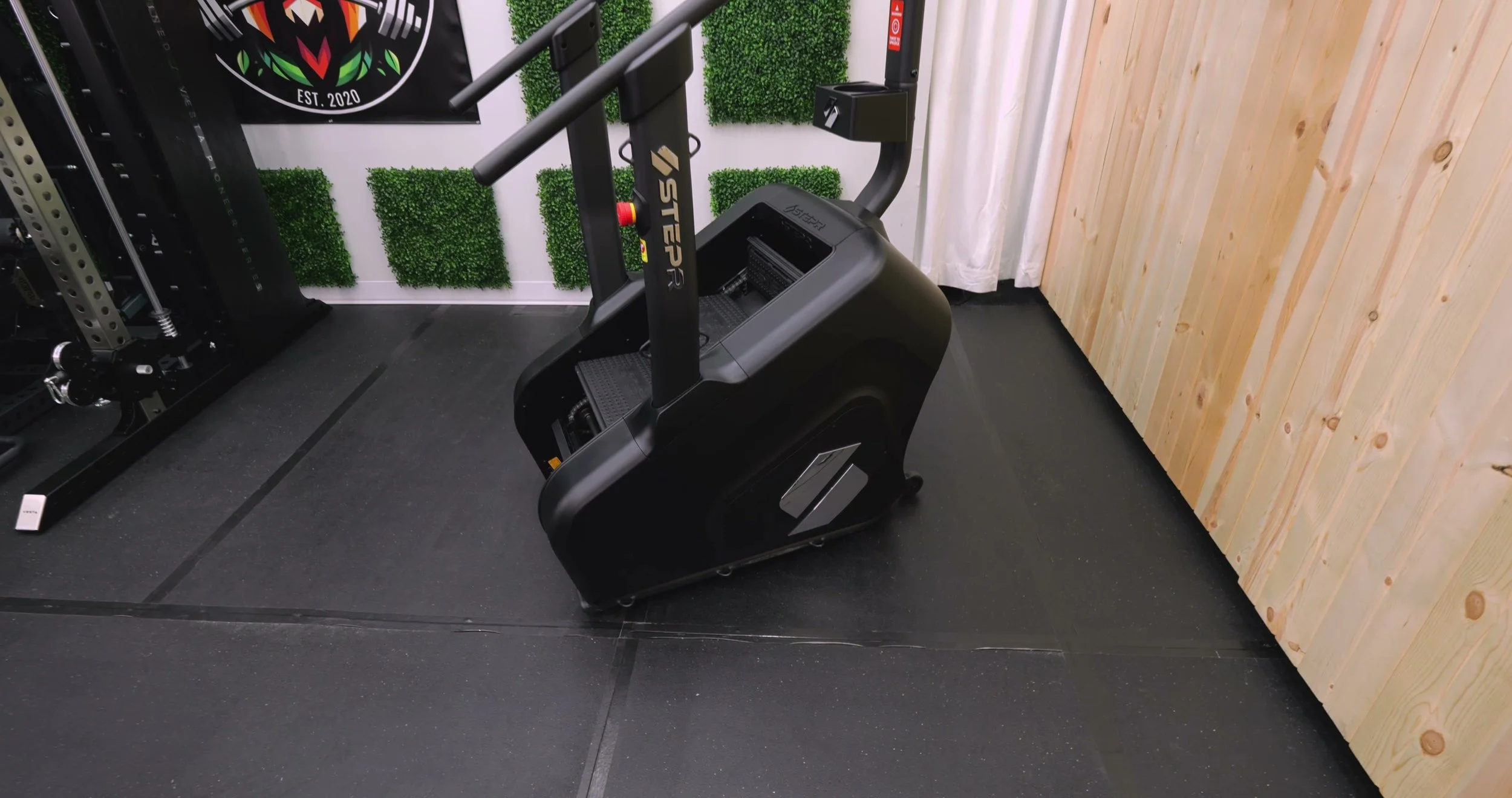
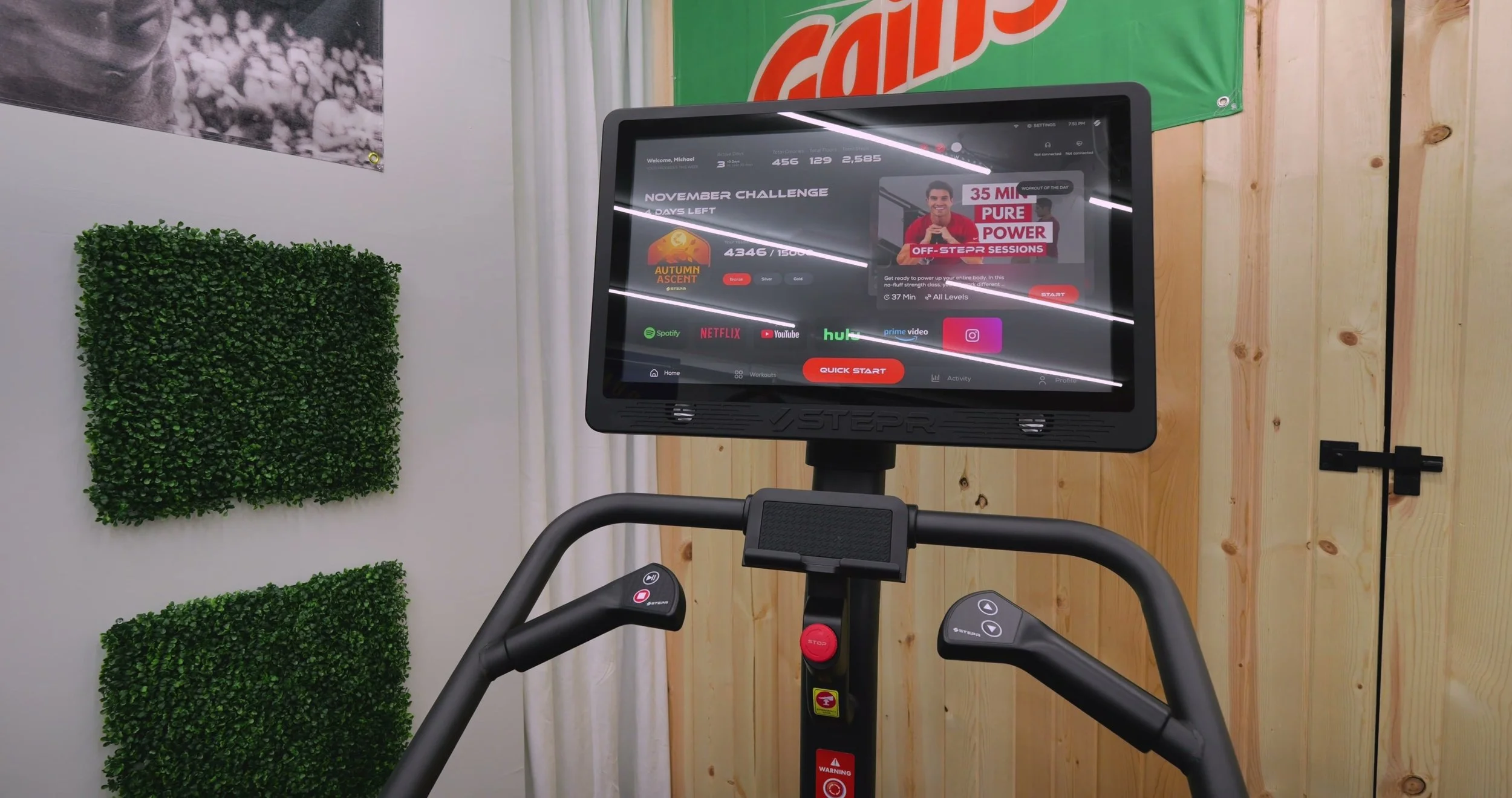
The 27-inch touchscreen is the biggest differentiator between the STEPR+ and the cheaper non-screen version. The screen tilts up and down to accommodate different user heights, though it doesn’t move forward or backward. Netflix, Hulu, Prime Video, Instagram, and other major apps work, and Bluetooth audio has been solid. It syncs quickly with my Wi-Fi and connects to my Whoop without issue.
There’s no required membership to use the core features, which is a big win. Netflix, YouTube, virtual hikes, and built-in workouts are all accessible without a paywall. STEPR does offer subscription classes, but the main functionality is included.
That said, the smart system is not perfect. YouTube has a known bug where the app crashes within the first minute. Support has acknowledged it, but it’s still unresolved. At this price point, that’s frustrating. Netflix, on the other hand, has been rock-solid. I’ve left it running overnight and come back the next day with no issues.
There’s also a screen freeze issue. If the machine sits idle for an hour or two, there’s about a 50/50 chance the screen won’t respond. The fix is a power cycle using the switch on the back, which takes about 40 seconds. It’s not a dealbreaker, but it’s annoying when you just want to hop on and go.
Another small but real usability quirk is scrolling. On some screens, touching the middle opens apps instead of scrolling. You have to use the white space between thumbnails. My wife figured this out after months of frustration. It’s the kind of thing you don’t expect to deal with on a premium touchscreen.
Bands, Workouts, and Extra Functionality
STEPR wants this to be more than just a stair climber. There are band anchor points welded onto the frame—front, back, and multiple positions—so you can do hybrid workouts that mix climbing with light resistance training. The screen rotates so you can face off to the side during these sessions.
I’ll be honest: I don’t use any of that. I use this machine to climb stairs. But if you want a cardio-plus-light-strength centerpiece and don’t own much other equipment, it can fill that role. Just don’t expect it to replace real strength training.
Value and Alternatives
At around $5,000 for the STEPR+, this is expensive. Even the non-screen version at roughly $4,000 isn’t cheap. My view is that if you’re already spending $4,000, the extra $700 for the screen is probably worth it, despite the software quirks.
The only real alternative I recommend is the Signature Fitness stair climber sold through Walmart. It’s around $1,500, you can add a three-year warranty for about $150, and you’re roughly $2,000 all-in. The downside is size and logistics. It weighs close to 400 pounds, won’t fit through doors easily, and ends up living in whatever room it’s delivered to. Longevity is also a question mark.
So the decision comes down to space, ceiling height, and how much you value a refined mechanical experience versus upfront cost.
Who Should Buy This
This is a great fit for home gym owners who want true stair climbing under standard ceilings, care about joint comfort, and are okay with some software imperfections. It works especially well for steady-state cardio and households where safety matters.
Who Should Skip It
If you have very large feet, want flawless app performance, or can’t justify the price, this may not be the right choice. People who have room for a full commercial stair climber may be better served elsewhere.
Final Verdict
As a stair climber, the STEPR+ works exactly how it should. The stadium steps are comfortable, the size makes home installation realistic, and the mechanical experience is excellent. The smart system has quirks that matter at this price, but for the right home gym, this fills a gap that almost nothing else does.
Affiliate Disclosure
This article may contain affiliate links. If you purchase through these links, The Jungle Gym Reviews may earn a small commission at no additional cost to you.