SaunaBox Solara Review
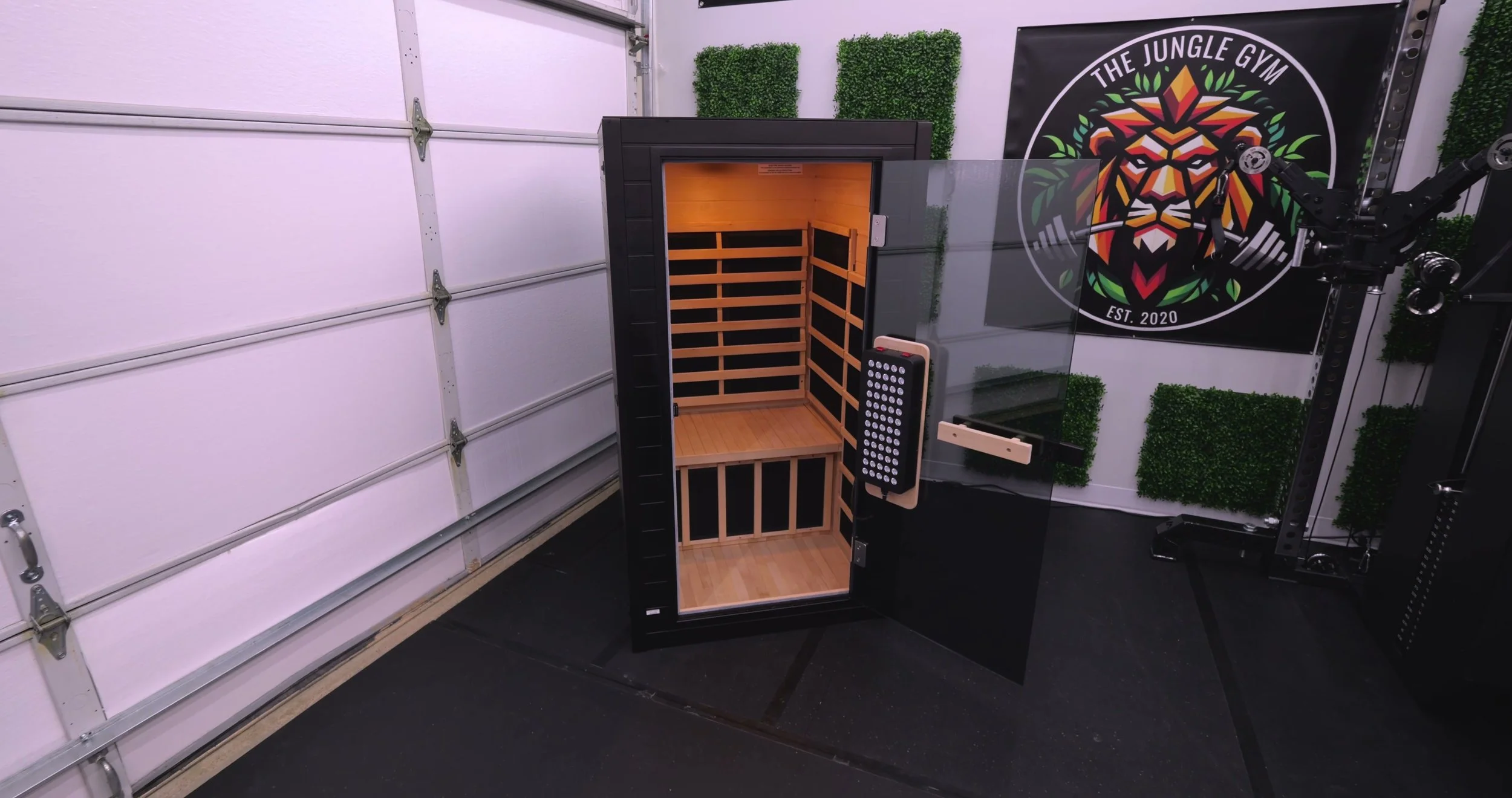
This product was in-house tested by Michael at The Jungle Gym Reviews.
If you want an indoor, plug-in (110V) infrared sauna that looks legit, assembles without drills, and can be moved room-to-room, the Solara does that really well. The main tradeoff is heat intensity and heat-up time: it tops out around 149–150°F and can take 30–45 minutes to fully preheat depending on your ambient temp. It’s best for people who want consistent, convenient sauna sessions at home—not people chasing a brutally hot, commercial-style experience.
Quick Specs
Product: SaunaBox Solara
Type: Single-person infrared sauna
Construction: Canadian hemlock wood
Power: Standard 110V outlet
Max Temperature: 149–150°F
Timer: Up to 90 minutes
Height: ~63 inches
Footprint: ~32” wide x ~35” deep
Weight (assembled): ~170 lb
Heat-Up Time (typical): ~30 minutes (warmer room) to ~45 minutes (40–50°F environment)
Primary Features Mentioned: Low EMF infrared heating, Bluetooth speakers, NIR infrared, red light therapy
Price (at time of filming): $2,999
Use Case: Indoor residential use
Where to Buy / Check Price
Check current pricing and availability on the official product page.
My Real-World Experience
My perspective on this is practical: I’m not a sauna technology expert, and I’m not trying to pretend I am. I’m looking at this like a home gym purchase—does it solve a real problem without becoming a huge install or a huge hassle?
The Solara’s biggest win is that it’s a compact, premium-feeling sauna that plugs into a standard 110V outlet. That’s the whole reason a product like this exists. If you want the “real install” experience—hotter temps, faster heat, bigger cabin—you’re usually talking 220V wiring, space planning, and a much more permanent setup. This is not that. This is the “I want a nice sauna at home without calling an electrician” lane.
At 6’2”, I’m basically a head (and close to shoulders) over the top of it height-wise, but stepping in and using it is still straightforward. It’s a single-person setup, and it does feel like a legit enclosed sauna experience once you’re inside and it’s up to temp.
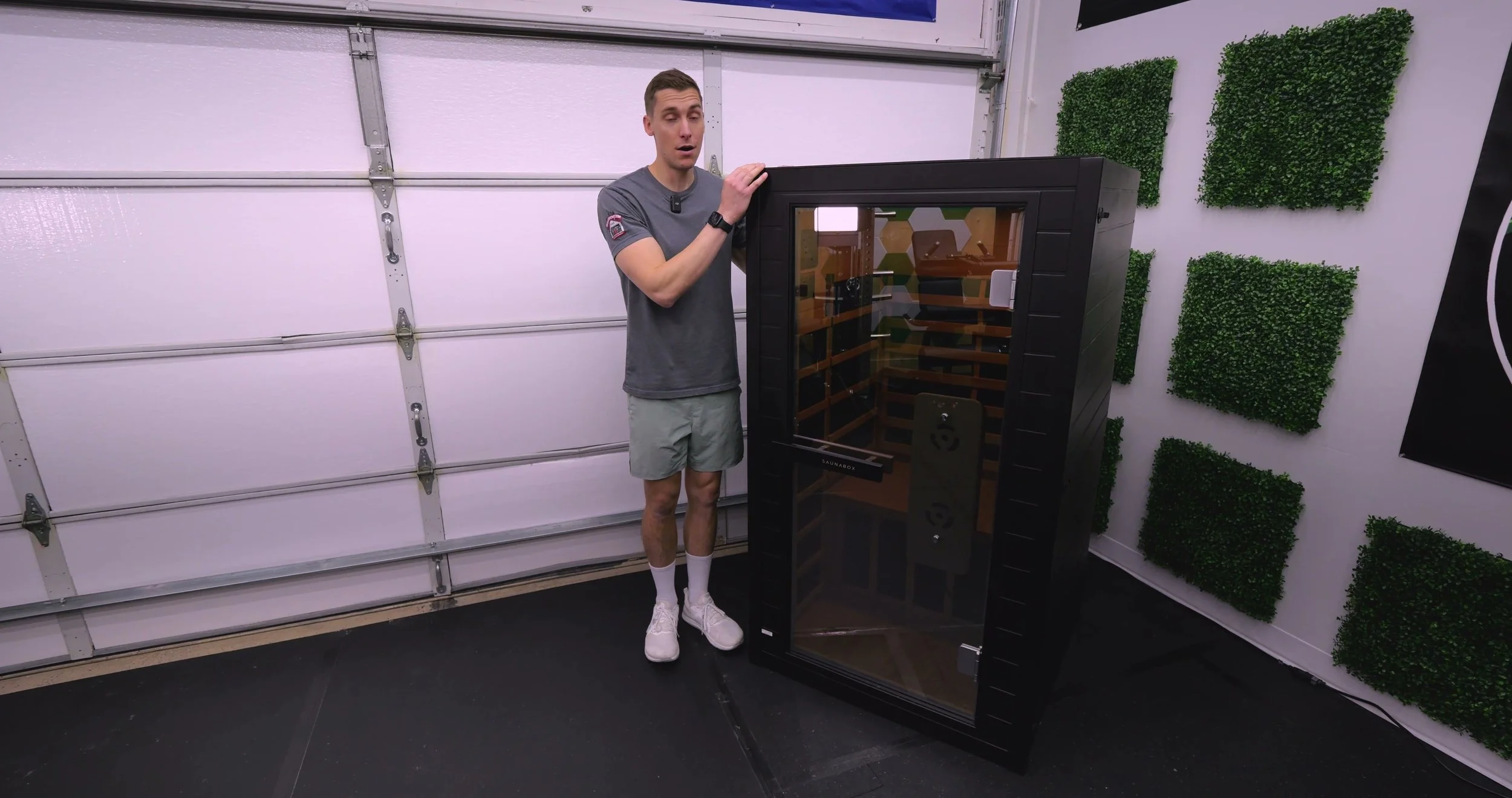
Heat-wise, it goes to around 149–150°F. I run cold, and at max temp it takes me roughly 10 minutes to start sweating. Personally, I like a sauna that hits harder and faster—where it “burns” a bit when you get in—and that’s the one area where you need to be honest about expectations. If you’re chasing that level of intensity, you’re probably looking at a bigger commercial-style sauna and a 220V dedicated circuit. For what the Solara is designed to be, the heat output makes sense.
Setup, Build Quality, and What It’s Like to Live With
Assembly is one of the strongest parts of this product. It’s basically a latch-together design: sides, back, and front panels, with multiple latches per side and in the back. No drills, no screws, no “construction project” vibes. It’s also light-duty enough to be moveable. Once assembled, you said it’s around 170-ish pounds—heavy enough to feel real, light enough that relocating it from one room to another is actually realistic.
The build quality feels like what I’d call medium-duty: not flimsy, not disposable, but also not “heirloom furniture.” It reminds me of IKEA/Wayfair in the sense that it’s designed to ship well, assemble easily, and be practical to own—not built like thick, heavy old-school cedar construction. The wood smells clean like sauna wood, and overall the finished look is upscale enough that it doesn’t feel out of place in a nicer home.
I also think it’s worth setting expectations for shipping reality: you may see scuffs, dust, minor scratches, or tape residue from packaging. That didn’t bother me, and I’d rather have a sauna that’s easy to ship and assemble than one that requires a full install.
The door is another highlight. It feels heavy (in a good way), closes with a magnet, and has a satisfying “solid” feel. The hinge doesn’t feel flimsy, and there are handles inside and out.
Features That Actually Matter
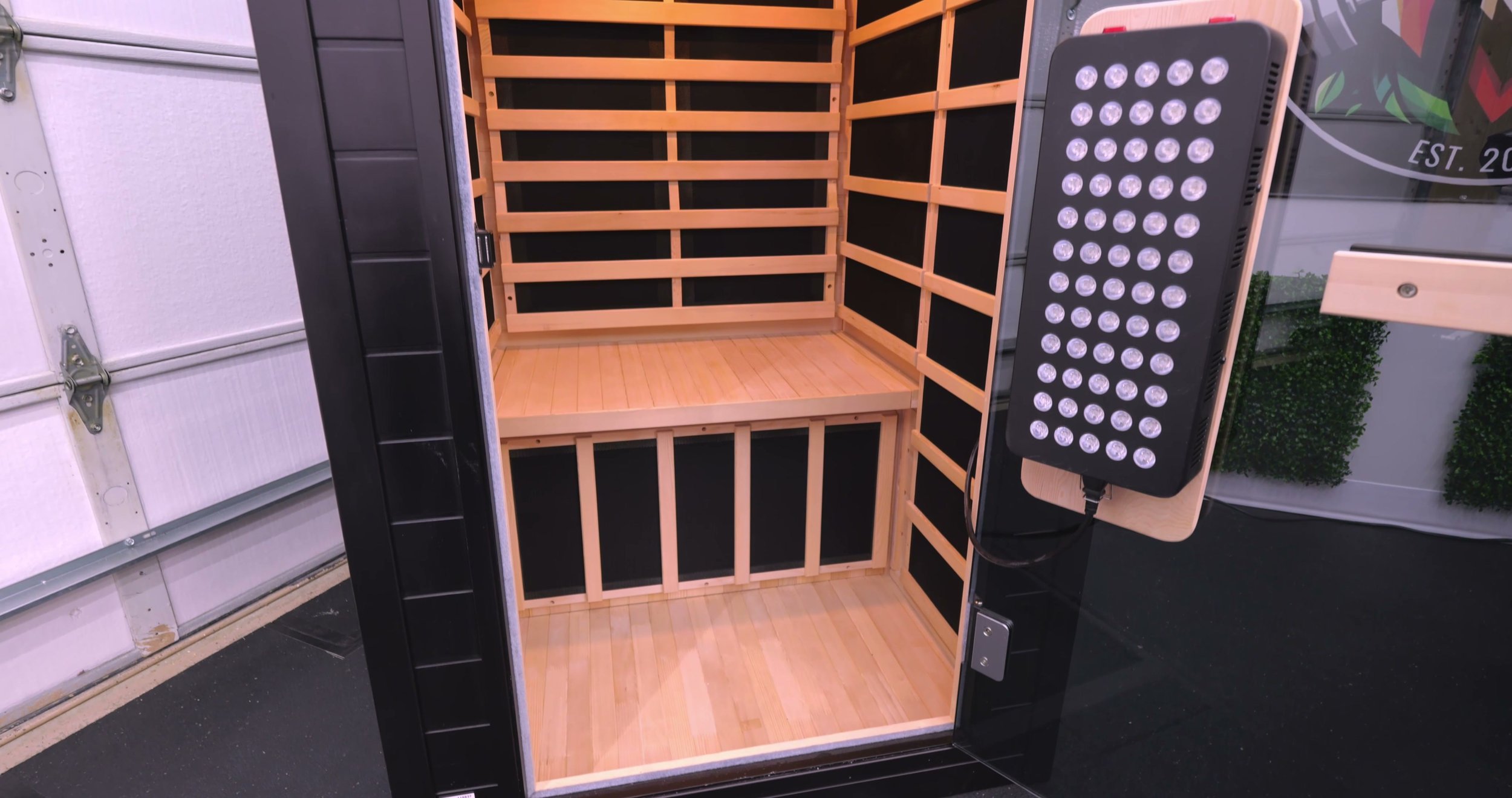
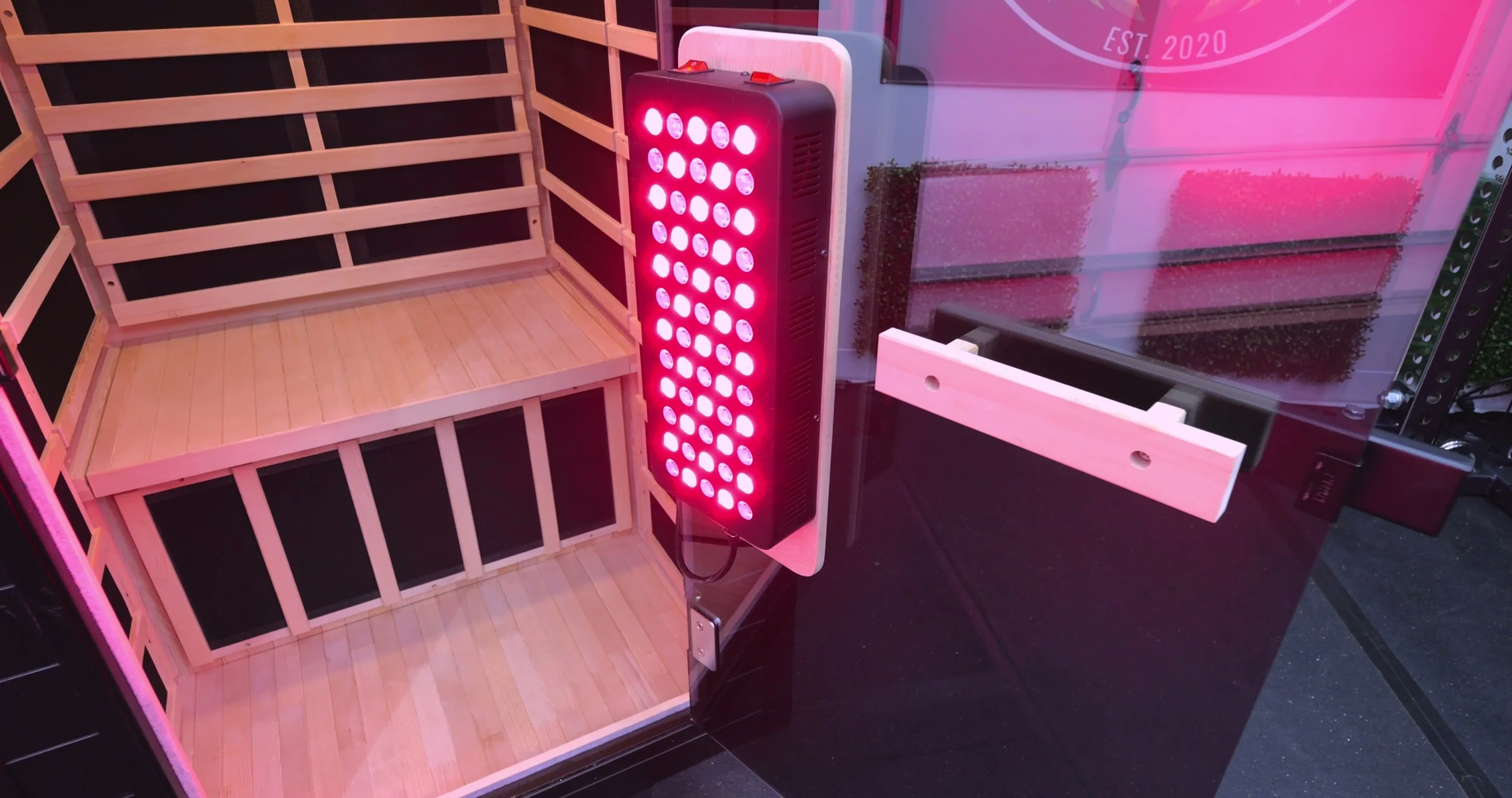
Inside, the black panels are the infrared heating elements. Up front, you’ve got red light and near-infrared panels. You turn the red light on for a few minutes during sessions. You also mentioned an important practical note: don’t stare at the red light—goggles are included. You personally don’t wear them because you can’t see anything, but they’re there.
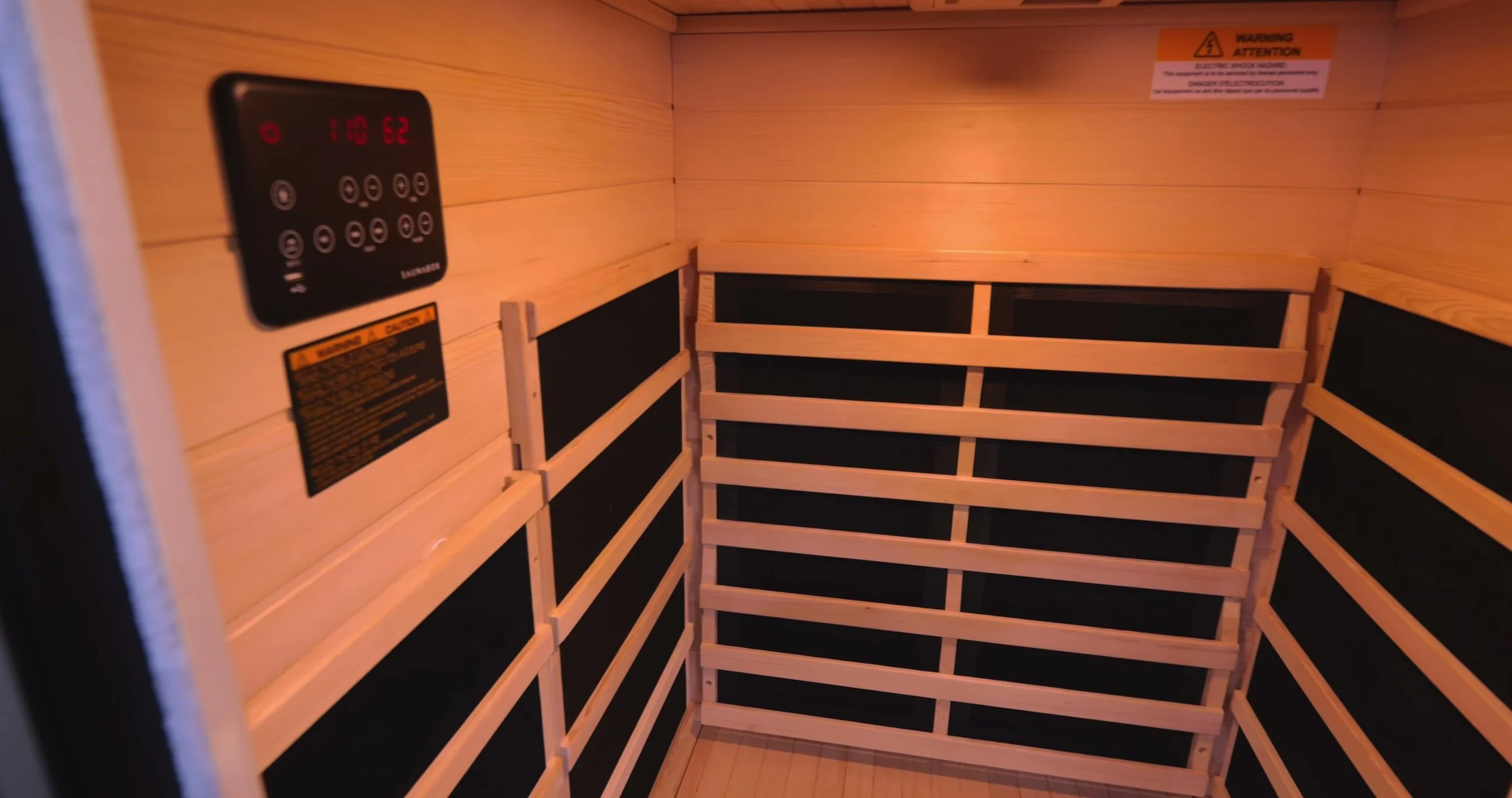
On the control side, it’s a simple touch panel. You keep yours set at 149°F with the timer at 90 minutes, and you just turn it on ahead of time when you want to use it.
The biggest real-world “workflow” detail: preheat time. In a normal indoor ambient temp (65–70°F), you’re around 30 minutes to heat up fully. In a colder environment like a garage/studio sitting around 40–50°F, you’re closer to 45 minutes. So if you’re the kind of person who wants to spontaneously jump in, you’ll have to retrain yourself a little—turn it on first, then go do something else for a bit.
Space and “Can Two People Fit?”
This is designed as a single-person sauna, but you mentioned two people can fit if you’re careful. At 6’2”, you could do it, but shoulders would be tight. Your wife at 5’8” could fit with you, cramped. Practical warning: be mindful of arms touching heating elements.
The One Real Issue You Ran Into
You had a quality issue with the vent panel at the top: the small piece meant to close the vent doesn’t fit properly and falls out quickly, which lets heat escape. Support is sending a full new top panel to resolve it, but you still have to pay $79 for shipping.
That’s the kind of thing I want people to know up front when they’re spending around $3,000—good support matters, but it’s still frustrating when the fix costs you extra out-of-pocket.
Tradeoffs and Limitations
The tradeoffs are pretty clear:
It’s not the hottest, most intense sauna experience (max ~150°F, slower sweat onset for you).
It takes real preheat time (30–45 minutes depending on where it’s placed).
The construction is intentionally lighter-duty so it can ship and assemble easily.
You had a vent-fit issue that required a replacement panel + paid shipping.
Value and Alternatives
This makes the most sense as the “premium home option that doesn’t require installation.” If you’re comparing it to pop-up tent saunas in the $300–$1,000 range, the Solara is obviously in another category in terms of aesthetics, feel, and the “real sauna in your home” vibe.
If you’re comparing it to full professional installs, it’s cheaper and way simpler to own—but you’re also not getting the same heat intensity, size, or permanence. In my opinion, this is the right buy for someone who wants a clean, upscale home sauna experience without a renovation.
Who Should Buy This
People who want an indoor sauna that plugs into a standard 110V outlet.
Anyone who cares about having a premium-looking, enclosed sauna versus a tent setup.
Home gym owners who want a recovery option that can move rooms if needed.
People who are OK planning sessions around a 30–45 minute preheat.
Who Should Skip It
Anyone who wants a truly brutal, commercial-style heat experience.
People who won’t use it if it’s not “ready instantly.”
Anyone who expects heavy-duty, lifetime-furniture-level wood construction.
Final Verdict
For what it’s designed to be—a compact, premium-feeling, indoor infrared sauna that assembles easily and runs on 110V—the Solara delivers. Just go in knowing the reality: it’s a “plan ahead and preheat” sauna, and if you want dramatically hotter, you’re looking at a different class of product and a different level of installation.
Affiliate Disclosure
This article may contain affiliate links. If you buy through them, The Jungle Gym Reviews may earn a small commission at no extra cost to you.